

Commercial Asphalt Paving in Lawrenceville, Georgia
Lawrenceville is a city built in contrast. Walk through the historic downtown square, anchored by the Gwinnett Historic Courthouse and its clock tower that has kept time since 1885, and you are standing in the oldest part of Gwinnett County. Drive a few minutes in almost any direction, and you are in the middle of some of the fastest suburban growth in the region.
Old Meets New
That contrast is not just a matter of history. It shapes what commercial paving actually looks like here. A lot near the square deals with decades of underlying infrastructure and pedestrian-heavy foot traffic. A lot in a newer retail center or office park a few miles out deals with an entirely different set of demands, often on pavement that is only a few years old.
A Historic Core Surrounded by New Growth
Downtown Lawrenceville has built its identity around this old-meets-new mix. The Gwinnett Historic Courthouse anchors the square, and nearby, the Aurora Theatre has turned a converted church into one of the largest professional theaters in the state, drawing crowds to what is now called the Lawrenceville Arts Center. The theatre alone brings tens of thousands of visitors downtown every year, adding a steady layer of foot and vehicle traffic on top of everyday business at the shops and restaurants nearby.
The Lawrenceville Lawn, a green space that hosts festivals and markets throughout the year, sits close by, along with newer mixed-use development like SouthLawn that has added housing, shops, and street-level retail right next to the historic square.
This downtown core also functions as a civic hub. City government offices, the Gwinnett History Museum, and other public buildings sit alongside the private restaurants and shops that give the square its character. Pavement here often needs to hold up to a mix of foot traffic, event crowds, and a steady flow of vehicles heading in and out of a compact downtown grid, all built around infrastructure that has been in place for generations.
Streets and lots in this part of the city were laid out long before today's parking demands existed, and that history shows up in how the pavement performs. Narrower access points, older drainage systems, and decades of accumulated wear all factor into how a downtown property holds up compared to something built in the last few years. Working around a historic streetscape, rather than against it, takes more planning than a straightforward suburban project.
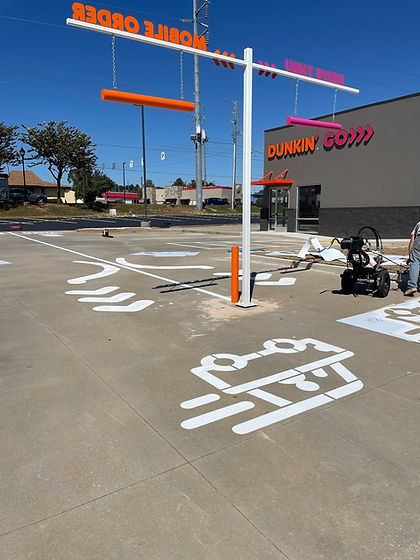
Older lots downtown, along with civic and government properties nearby, are frequently reaching a point where basic patching no longer solves the underlying problem. In these cases, full-depth asphalt reconstruction becomes the right call once a lot's base has genuinely failed, and commercial parking lot replacement is often the more practical path forward for a downtown property that has been through years of repeated repairs. Between bigger projects, parking lot striping & pavement markings keeps these older, high-visibility lots safe and clearly organized for the steady foot and vehicle traffic downtown sees.



Where Growth Is Happening
Just outside the historic core, Lawrenceville looks very different. Retail centers, office parks, and multifamily developments have expanded steadily along the corridors surrounding downtown, including areas near Sugarloaf Parkway and the broader routes connecting Lawrenceville to the rest of Gwinnett County. Georgia Gwinnett College, located just outside downtown, has also driven growth in nearby retail and housing built to serve students and staff.
This growth has changed the shape of the city over the past two decades. What used to be a smaller courthouse town surrounded by farmland has become one of the more active suburban markets in the Atlanta metro area, with new commercial development continuing to fill in along its major corridors. That growth shows no sign of slowing, which keeps steady demand flowing for paving work tied directly to new construction rather than repair.
This kind of suburban expansion creates real demand for new paving work, not just upkeep on what already exists. New retail centers and office parks need commercial parking lot construction built from the ground up, matched to how the property will actually be used. Industrial and logistics activity, common throughout Gwinnett County, brings a need for industrial yard & heavy-duty asphalt paving and warehouse & distribution center paving wherever heavier vehicle traffic is part of daily operations.
Meanwhile, multifamily developments and HOA communities expanding around the city often require private road & roadway paving for the internal roadways that come with new residential growth.
A Market That Needs Both New Construction and Ongoing Maintenance
What makes Lawrenceville distinct is that both sides of this contrast are active at the same time. The historic core is not standing still. It continues to see redevelopment and reinvestment, which means older infrastructure gets revisited even as it keeps its historic character. At the same time, new growth on the outskirts keeps generating fresh paving needs that have nothing to do with age and everything to do with keeping pace with development.
For a paving contractor, that means Lawrenceville is never a one-note market. A property owner downtown is often thinking about how to extend the life of pavement that has already been in place for decades. A property owner in a newer retail center or office park is thinking about building something correctly from day one. Both are equally common here, and neither approach fits the other's situation.
Understanding which category a property falls into, and sometimes a single portfolio includes both, is the starting point for any paving plan in a city like this one. Treating every project the same way, regardless of whether it sits on a decades-old downtown lot or a newly cleared suburban site, tends to produce work that fits neither situation particularly well.

Getting Started on a Project in Lawrenceville
Gwinnett County continues to see substantial business investment and job growth, reflecting just how much development activity is happening across cities like Lawrenceville. Resources like Explore Gwinnett, the county's official tourism organization, highlight how much is happening across Gwinnett's downtowns and commercial districts, while the Gwinnett Daily Post, based right in Lawrenceville, offers ongoing local coverage of the growth and development shaping the city and county.
Whether a property sits in the historic downtown core or out among the newer retail and office development surrounding it, the right paving plan starts with understanding which side of that contrast it falls on.
Reach out to talk through your property's specific situation, and get a plan built around what it actually needs, not a generic approach borrowed from a different kind of market.