

Commercial Asphalt Paving in Sandy Springs, Georgia
Sandy Springs is not a typical suburban market. It is one of the most business-dense communities in metro Atlanta, home to a concentration of corporate headquarters and professional office space that few surrounding cities can match.
Paving for a Business-Dense Market
Along the GA-400 corridor and the streets that feed into it, corporate campuses, medical office buildings, and upscale retail sit within a few miles of each other, each with its own set of paving demands that go well beyond a standard suburban parking lot.
Top Line Striping works with property managers, facilities directors, and developers across Sandy Springs, and understanding this market starts with understanding what makes it different: a high concentration of properties where appearance, durability, and daily traffic volume all carry more weight than they would in a typical commercial district.
A Market Defined by Corporate and Professional Property
Hammond Drive anchors much of Sandy Springs' office presence, lined with corporate campuses and mid-rise office buildings that house everything from regional headquarters to professional service firms. Nearby, the Concourse Corporate Center, recognizable by its King and Queen towers, sits at the edge of the broader Perimeter Center business district, one of the largest concentrations of office space in the Southeast.
This density of corporate real estate is part of what defines Sandy Springs as a submarket within metro Atlanta. Major employers have chosen to headquarter or maintain significant operations here precisely because of the concentration of talent, amenities, and infrastructure already in place, and that concentration keeps commercial development active year after year, from ground-up construction to the steady stream of renovation projects on older buildings.
New corporate development continues to bring fresh commercial parking lot construction projects to the area as companies build out campuses along these corridors, matched to the traffic and appearance standards a corporate tenant expects from day one. Many of these office parks, though, were built decades ago, and aging pavement along Hammond Drive and surrounding streets is increasingly reaching the point where commercial parking lot replacement makes more sense than continued patching.
Along Mount Vernon Highway and the area often called Pill Hill, home to a dense cluster of hospitals and medical office buildings, older lots that have carried decades of high-turnover patient and visitor traffic are frequent candidates for full-depth asphalt reconstruction, since base failure under that kind of sustained use rarely responds to surface-level fixes.



Where Appearance and Upkeep Carry Real Weight
In a market like Sandy Springs, a parking lot is not just infrastructure. It is one of the first things a client, tenant, or patient notices before ever walking through the door. Corporate tenants signing multi-year leases expect the properties around their offices to reflect the same standard as the space inside them, and property managers are frequently judged on how well they maintain that standard between major renovations.
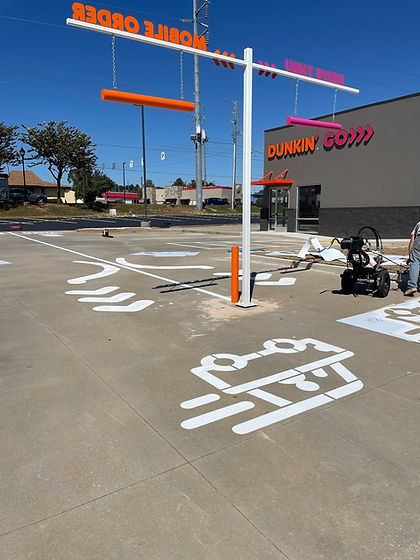
Retail and dining developments along Roswell Road and the corridors near Abernathy Road see this pressure just as directly. These properties compete for customers in a dense retail environment, and faded striping or a cracked, patched-over lot sends a message that undercuts the upscale experience the tenants inside are trying to deliver. Regular parking lot striping & pavement markings keeps these high-visibility properties looking as sharp as the storefronts they surround.
City Springs, the city's mixed-use downtown built around its Performing Arts Center and City Green, reflects just how much weight Sandy Springs puts on presentation. Public and private investment in this area has set a visible standard that surrounding commercial properties are increasingly expected to match.
Newer mixed-use developments like this one, along with the multifamily communities that have grown up around them, frequently need private road & roadway paving for the internal streets and shared access roads that connect residential, retail, and office space within a single development.
Traffic and Durability Demands of High-Occupancy Properties
A corporate office building or a major medical campus does not see occasional traffic. It sees hundreds, sometimes thousands, of vehicles moving through the same lot every single day, often on a predictable weekday schedule that leaves little room for pavement to recover between peaks. That kind of sustained, high-occupancy use puts real pressure on both the surface and the base underneath it, in a way a lower-traffic suburban property rarely experiences.
Some Sandy Springs properties also support logistics and distribution functions tied to the corporate presence in the area, from fleet and delivery operations to light industrial space supporting nearby office campuses. These properties often call for industrial yard & heavy-duty asphalt paving or warehouse & distribution center paving, built to handle repeated heavy vehicle traffic that a typical office parking lot was never designed to absorb.
Properties near GA-400 and I-285 see some of the heaviest and most consistent traffic in the area, simply because of how central those corridors are to commuting patterns across the region. Pavement built for this kind of daily volume needs a level of durability that a lower-traffic suburban property would not require, and cutting corners on base depth or drainage planning tends to show up as premature wear far sooner than it would elsewhere.
Property managers overseeing high-occupancy buildings also have to think about disruption. A lot that serves hundreds of daily commuters cannot simply close for an extended period without real consequences for tenants, so planning paving work around a building's actual occupancy patterns matters just as much as the paving itself.


Getting Started on a Project in Sandy Springs
The area remains home to a significant share of the region's major employers, reflecting just how concentrated the business community here really is. Visit Sandy Springs, the city's official tourism and hospitality organization, highlights the density of hotels, dining, and event space that supports this business activity day to day, while Rough Draft Atlanta's Sandy Springs coverage offers an ongoing, close look at development and business news shaping the city.
That combination of corporate density, high daily traffic, and a market where appearance genuinely affects how a property is perceived sets Sandy Springs apart from most of the surrounding suburbs. A paving plan built for a market like this one has to account for all three factors at once, not just the ones that happen to be easiest to address.
Every property in Sandy Springs, whether it is a corporate campus, a medical office building, or a retail center along Roswell Road, has its own combination of traffic, visibility, and durability needs.
Reach out to talk through your property, and get a paving plan built around the standard your tenants and clients expect.